June 12, 2011

What Is Godliness?

I was recently asked to speak in church and this was the result.  I realize it's a repeat of many of the ideas I've expressed in this blog, but it's an attempt to put many of them together into a cogent argument.
________________________
Some of the finest people I’ve ever met were dogs, and that’s especially true of Jesse, the sleek and long-legged black lab that Lori and I had in our home for many years.  One day Jesse and I were walking on a favorite trail in Briones, when we noticed a strange plant obscured by shadows on a hill.  It was shaped like a paddle and stood tall above the grass with a bushy black fringe and a white stripe down its middle.  As Jesse bounded ahead to investigate, I scratched my head, wondering what kind of plant it could be. 
That’s when it did the inexplicable: That plant took a step or two back.  Now, I might be a nuggat short of a nut cluster, but I’m smart enough to know a couple of things: 1) plants shouldn’t oughta do that and 2) the description of a “black fringe with a white stripe down the middle,” could apply to something that wasn’t a plant at all.  Regarding the events of that day, I later wrote a poem that goes like his:

I commanded, “No!”
But still he leaped,
Then whirled in midair,
Blinded and sneezing,
Frothing from the mouth.

As for the skunk,
It wandered off,
Unbothered,
Just another day
For a being possessed with power
Worthy of a comic book character.

It was a bad morning to be without a long leash.
Hand to collar,
We stumbled to the nearest pond,
Barely able to breathe,
Rubbing the stink and the sting
From our tear-filled eyes.

Oh, I dunked him—
Rest assured I dunked him good—
Muttering all along,
“You darn dog.”

On the way home—
He in back,
Muzzle on paws,
Sad eyes only now opening
To the possibility of new
And disquieting hazards—
I lowered all the windows
And laughed into the passing breeze.

So what if the Jeep will never be the same?
Will I condemn the penitent
For his most endearing
Instincts and preoccupations:
Childlike enthusiasm
And boundless curiosity?

Perfection is unwarranted.
Give me quirkiness instead,
And other sweet foibles
In their glorious variety.
If so blessed,
Laughter and affection will accompany me
Everywhere I go.

I entitled the poem, Brushing Up to Godliness, to convey the idea that in Heavenly Father’s intercession with humanity, we see clues to how our mortal obligations might be fulfilled.  The trouble is that even when following Nephi’s admonition by “likening all scriptures unto us,” we can justify disparate behavior in ways resulting in moral ambiguity.  In response to Jesse’s disobedience, for example, I could have smote him as a sinner or reassured him with a hug.  The options are as different as chalk is to cheese, but still supported by scripture. 
That brings me to the subject of my talk: What’s God’s true nature and what did our Savior say about Godliness?  The answers are critical, because to understand what God stands for is to know what to emulate.  
I once thought of our Father in Heaven as a kind of exalted venture capitalist.  Sure, His rewards were great, but when dealing with His creations, He was tough and demanding, willing to fire those who didn’t produce and cut His losses when displeased with results.  That notion of Godliness translated into a premise that ruled my existence.  I believed there was only one excuse in life and it was this: I didn’t want it badly enough.
I truly believed that a lack of desire and hard work was all that kept anybody from any achievement.  That worldview made me awfully intolerant.  (Actually, Lori had a better word for me, but we won’t go into that).  I had no patience for the castoffs of the world, because where I saw privation, I could write it off as an example of people who didn’t want the alternative—a good life—badly enough.  
There is, however, a gentler version of Godliness—one expressed in Christ’s declaration to a fallen Israel:

How often would I have gathered thy children together, as a hen doth gather her brood under her wings…

This form of Godliness considers the interests of others as equal to its own and was practiced by Christ’s followers prior to the convening of the First Council of Nicaea.  As described in Acts 4:32-35: 

…the multitude of them that believed were of one heart and of one soul…  Neither was there any among them that lacked: for as many as were possessors of lands or houses sold them, and brought the prices of the things that were sold, And laid them down at the apostles’ feet: and distribution was made unto every man according as he had need.

Elaine Pagels, a Pulitzer-winning author and historian of the early church, describes a remarkable people who fully deserved the title of saint.  While Rome entertained itself with the public slaughter of Christians, the surviving faithful sustained each other in communal enclaves.  They gave the indigent and homeless—especially abandoned children who were numerous—a place of unquestioned welcome and belonging.  When plagues struck and cities were abandoned, Christians were the few who remained behind to practice literally the Savior’s admonition to feed the hungry, clothe the naked and administer to the sick. 
While such sacrifices are inspiring, they can still be viewed in one of two ways: either as 1) noble, but unnecessary, or 2) the fulfillment of the true intent of Christ’s gospel.  If you believe in the Apostasy, however, there’s not much of a leap in logic to assume that the early Christians had it right, until something went terribly wrong.  What went wrong is beyond the scope of my talk, but Pagels, as well as other historians, have written extensively on the topic.  It’s enough to know that many early Christian traditions were violently crushed by a powerful orthodoxy and one tragedy of that history is that a central message in Christ’s Sermon on the Mount was misinterpreted for political gain.  That message, found in Matthew 5:17, reads:

Think not that I have come to destroy the law and the prophets, I come not to destroy but to fulfil.

Now, the first part of the verse isn’t subject to debate.  In it Christ claims He has no intention of destroying the Mosaic Law, which on this and other occasions He refers to as, “the law and the prophets.”  What’s less clear, however, is the final clause.  How did Christ intend to fulfill the Law of Moses? 
Many fundamentalists believe that Jesus affirmed the Mosaic Law as His gospel and in doing so they practice a faith that is far more Levitical than Christian.  Yet, if we read what follows Matthew 5:17, we can clearly see that Christ had no such intention.  To understand what He did mean, it’s helpful to refer to the original Greek text of Matthew, from which the word pleroo was later translated into that elusive term fulfill
Pleroo is a word that conveys multiple nuanced meanings, but it’s generally translated as: to fill to the top, to cram down, or to make complete.  Knowing how Christ fills or completes the Mosaic Law is critical, so I’ll summarize what I understand about the subtlety of the term.  If I have a bottle that’s nearly full of water, which I then fill to the rim, stopper and set aside, I’ve pleroo-ed the bottle.  Notice that while I’ve filled it, I’ve also rendered the bottle useless as a vessel that can store more water.  And that’s an essential sense of the word.  In fact, it’s sometimes translated as meaning to render obsolete. 
The correct view of Matthew 5:17, therefore, is that Christ didn’t destroy Leviticus, but He nevertheless rendered it obsolete.  Just like we can still use typewriters in a computerized world, we can follow the Law of Moses—if we choose—but Christ wants us to be better than that and graduate to a standard more powerful and grand.  He describes that better way in five telling passages in Matthew 5, the first of which is found in verses 21 and 22:

Ye have heard that it was said by them of old time, Thou shalt not kill…But I say unto you, That whosoever is angry with his brother without a cause shall be in danger of the judgment…

By these verses, Christ asks us to do more than simply refrain from murder, but to exact discipline over our passions.  In the same way, He invites us in four subsequent passages to: 1) Do more than abstain from adultery, but bridle our appetites, 2) Do more than just honor our contracts, but be true to our word, 3) Refrain from vengeance and instead forgive and 4) Do more than love those who love us back, love all of God’s children.
We could spend hours discussing each one of these critical passages, but let me say a few words about one of them.  Verses 38 and 39 say:

Ye have heard that it hath been said, An eye for an eye, and a tooth for a tooth: But I say unto you…whosoever shall smite thee on thy right cheek, turn to him the other also.

The notion that we must demand an eye for an eye was never meant as a requirement even in Moses’ day.  Think of where his people had been.  They’d suffered through 400 years of bondage, during which the capricious whips of their Egyptian masters had been their only measures of justice.  To them, the penalty for a stolen crust of bread might have been the loss of a hand, but Moses told his people not to be like that—to allow no punishment to exceed its crime.  The reason for the law was to establish a maximum penalty, not to require one.  In contrast, the gospel standard is more explicit.  Christ wants us to forgo retribution altogether.  
You might very well ask what this has to do with God’s true nature, and I will answer:  Everything.  Can you imagine Heavenly Father demanding from us one thing and doing another?  Neither does our Savior, since He says in the final verse of the chapter:

Be ye therefore perfect, even as your Father which is in heaven is perfect.

We gloss over this verse or read it without context, but it's a scripture that begs for context.  Why?  Because it includes the conjunction “therefore,” which is a word used to connect a premise to a conclusion, as in the relationship: A therefore B.  The premise here is Christ’s description of His gospel found in the passages I've just cited.  It leads us to the conclusion, found in the latter part of the verse, that Christ’s perfect gospel is what God not only honors, but practices.  In other words, Heavenly Father is in control of His passions and appetites—He isn’t vengeful, or jealous.  He’s forgiving and true to His promises—He doesn’t abandon His children.  His love knows no bounds—He doesn’t play favorites.  And we should do the same.
Now, I know what you’re thinking: Why is Alan, who isn’t even an active member of the ward, talking about Godliness?  You have a point.  There’s no question that I’m an awful human being.  I realized decades ago that I had neither the courage nor the fortitude to live Christ’s gospel—at least, not the way He’d intended.  If there’s a Celestial Kingdom, I won’t be there.  Visit me, please.  But even though I’m a goat among the Shepherd’s flock, that doesn’t mean I don’t love the Shepherd.  He’s taught me too much—including many tough lessons that He had to nurse me through—not to love Him dearly.   
Now, here’s a note about those tough lessons.  A funny thing happened to me on the way to thinking I was in complete control.  First, I noticed how the difference between success and failure could be measured by a moment of hesitation, a step in the wrong direction, or an accident of geography.  Then my smug and self-assured worldview was crushed in a deeply personal way when my oldest son tried to take his life.  If I’d wanted anything more urgently than the need to breathe, it was for him to be happy, but I couldn’t will it so. 
I won’t explain what it’s like to raise a depressed child who self-medicates as an escape.  I won’t tell you what goes through a father’s mind as his son spends a night behind bars, or is institutionalized on suicide watch.  What I will say, however, is that Lori and I never—not once—ever considered cutting our losses or walking away from that beautiful boy we’d helped bring into the world.  We’d loved him before he could walk.  We’d loved him before he could speak.  We could do no less, even though he was blind to the seed of divinity inside him.  Could Heavenly Father do any differently?
Despite our chest-thumping demonstrations of toughness, we humans are terribly fragile creatures and many of our brothers and sisters don’t deserve and cannot prevent their unfortunate circumstances.  They could also benefit from our better attempts at Godliness.  In closing, I’ll read an excerpt from a letter I once wrote to a friend who was going through a though time.  In it, you’ll hear what life experience and Jesus have taught me about God’s true nature. 

Why do we love our children?  Is it because they spring from the womb with Olympic medals on their chests, Harvard diplomas in their hands, and the chiseled good looks of Venus or Adonis?  Obviously not.  Children are born plain and without any means of survival beyond an instinct for growth.  So we love our children despite their weaknesses.  Or do we?
Let me tell you a secret.  When Matthew was born, Lori and I looked at each other and in one spontaneous voice whispered, “He looks like Jabba the Hut!”  With his pressed face, frog-like legs, and catfish-skin belly, he really looked like a Star Wars’ character, but this endeared him to us all the more.
During the inexplicable moments when I feel God’s presence most vividly, a picture enters my head.  I see a smiling Father kneeling on the floor along one side of a spacious room.  His arms are spread wide and He entreats me to take awkward, first steps toward Him.  And when I stumble (as I am prone to do) gaining His forgiveness always seems easier than forgiving myself.  Sometimes I’d rather remain on the floor to pout and be punished with thoughts of my enormous stupidity.  But He tells me to put away the excess baggage, to rise up and attempt again, to take a few more steps—as awkward as they may be—toward Him, toward Godliness.

May we understand and emulate God’s great love for His children, I pray in the name of Jesus Christ.  Amen.

June 10, 2011

The Gods We Worship

As an investment banker, I used to think I was pretty hot stuff.  In fact, I was so full of myself that when I read Tom Wolfe’s remarkable novel, Bonfire of the Vanities, the failings of the characters barely registered with me.  The main point I got out of the book was the notion that I was part of a special breed.  Investment bankers, I’d come to decide, were truly Masters of the Universe. 

Back then I had Asia Pacific responsibility and traveled a bit.  One day I was in transit between someplace I don’t recall and home, when I walked into the duty free shop in the Hong Kong airport with layover time on my hands.  Among the upscale items for sale there I noticed some beautiful Hermes ties that were in vogue among bankers at the time.  Thinking they would aid in portraying me as a successful professional, I purchased two without much additional consideration.  The Hermes brand, after all, had become a kind of badge, an indication of competence and a charmed life, which was how I desperately wanted people to think of me.

Later on the plane home, I was bothered by the purchase.  The price tag had been denominated in Hong Kong Dollars and I’d not paid complete attention to the cost in greenbacks.  When I did the calculation, however, I realized I’d just purchased two ties for $500.  I was sick over the transaction and it made me wonder how I’d become so concerned with personal image to be that careless.

A couple of nights later, I had a strange, but vivid, dream.  I was suddenly sitting in a large stadium (I’m pretty sure it was Candlestick Park) with an immense crowd of people.  I don’t know why I knew, but I could sense that we’d all recently died and had gathered to find out what would happen to us next.  As you might imagine, there was a feeling of great anticipation and excitement that the stadium could scarcely contain.  Suddenly an announcement came over the loudspeaker in the voice of a circus barker. 

“Now’s the time you’ve all been waiting for,” the voice said, “Behold!  God the Father and Jesus Christ!”

A cheer erupted and from across the field, a magnificent stretch limousine appeared and drove stately toward second base.  Once the vehicle stopped, a driver stepped out to open one of the back doors and two elegant couples emerged.  The women—dressed in formal attire and furs—were dripping with jewelry.  The men, whom I took to be Heavenly Father and Jesus, both wore full-length Alpaca coats and impeccably tailored suits.  They, too, were glittering with what kids today would call bling.  As the couples stepped out of the limo, they smiled and waved to the cheering crowd.

I remember being horrified with the image.  I kept thinking: This can’t be God.  This can’t be the Savior, who lived simply and eschewed privilege. 

I was so alarmed that I awoke in a sweat, just as if I’d had the most frightening of nightmares.  But as I emerged from sleep, the voice from the stadium loudspeaker spoke again.  This time the circus barker cadence was gone and the voice was quiet and serious. 

“No,” it whispered.  “This isn’t God, but it’s what you’ve come to worship.”

May 26, 2011

Hate and the Westboro Baptists

You've probably heard already, but the Westboro Baptists are at it again.  They're apparently heading to Joplin Missouri to celebrate the tornadoes as God's punishment to a nation of sodomites.  This is the same group that pickets funerals of soldiers and has an agenda of hate that takes aim at virtually everyone but themselves. 

They have deservedly become the most despised people in America, but this is what confounds me: Their doctrine isn't so different than that of mainstream fundamentalists.  The Westboro fringe only go to greater lengths to promote their ideas.  Their leader, Fred Phelps, isn't alone in believing that God causes natural calamities wherever homosexuals are made welcome.  Pat Robertson has said the same thing.  In fact, a listing of Christian leaders who've made similar statements could fill pages.

But is that really who God is?  If so, I would rather not return to a Creator who kills innocent people for acting out on the instincts He imbues into them, but that's NOT who He is.  Summarizing His infinite patience and forbearance, Christ once said: "How often would I have gathered thy children together, even as a hen gathereth her chickens under her wings." 

That's my image of God.  As for Phelps and the other Westboro Baptists, their hate speaks only of the ugliness they've allowed to fester inside them and not of their Creator.

May 22, 2011

Aggression in its Most Elegant Form

On Wall Street, a measure of a person's suitability to the work is his or her level of aggressiveness.  I've participated in countless meetings where people were critically evaluated on the basis of this metric.  I'm sure other industries and settings are similar in this regard.  In fact, it seems to me that aggressiveness is deemed an indication of a charmed life.  We applaud people who refuse to lose and go to great lengths to get what they want.  Winning, after all, isn't everything.  It's the only thing. 

The problem with this is that when the results of voracious acquisitiveness are admired to the exclusion of the processes by which goals are accomplished, people go to harmful lengths to achieve success.  Doping in sports, white lies on loan applications, quid pro quos that line political pockets but hurt community interests are just a few examples of what invariably occurs. 

Recently the auto company, Nissan, added to our preoccupation with success at all costs with ads that include the words: Aggession in its most elegant form.  What group of geniuses thought that was a good tag line?  I suppose they figured we needed more road rage, not to mention commuters swerving in and out of lanes to save 30 seconds.  They must have concluded our byways needed a few more arrogant drivers who think a yellow light means "speed up" and that another drink (or business conversation on a cellphone) won't diminish their superior driving skills. 

After seeing one too many of these ads, I've decided to never consider buying a Nissan--not if the company continues to romanticize aggression as elegance.  My favorite writer, John Steinbeck, once summarized my point in the following way:
The things we admire in men, kindness and generosity, openness, honesty, understanding and feeling are the concommitants of failure in our system. And those traits we detest, sharpness, greed, acquisitiveness, meanness, eogtism and self-interest are the traits of success. And while men admire the quality of the first they love the produce of the second.
Let's all agree that aggressiveness that aims for success to the exclusion of fairness, honesty and generosity, is the opposite of whatever elegance claims to be.

May 21, 2011

How Did the Rapture Work Out for You?

If you're reading this, I'm guessing you weren't called home in the rapture.  Join the club.   

I wasn't horrified by my continued presence in mortality.  My wife and I often say (tongue in cheek, of course) that we know we're going to hell, but at least we'll be entertained by the surprised looks on people's faces when they realize they've joined us there.  In fact, I've not spent a minute even considering the possible timing of an apocalypse.  There's too many other things to worry about--things that we have some amount of control over--including: global warming, the growing divide between the haves and have nots and war. 

Here is where I stand regarding the obsession over the End Times.  If we diverted the energy many people spend in determining when the events in Revelation will happen in favor of activities that actually bless the lives of others, we'd be far better off.  There's a corollary among some of the LDS faithful, who spend oodles of money in trips to Central America to visit ruins that they believe are evidence of the civilizations described in the Book of Mormon.  These efforts are akin to apologetic thinking, which only comforts people in their beliefs and leads to no real improvement in their lives.  It's like painting by the numbers: decorous, but without a soul. 

Let's stop speculating about things even Christ said we can't predict and use that energy to solve real problems.  Is it a deal?

May 8, 2011

Aaron's Home!

My youngest son, Aaron, is home for a short break from school and that means live music is in the house again.  When he was growing up, evenings here were like having a stage-side seat at Yoshi's.  Well, that might be an exaggeration, but you get the idea.  I loved to hear him play.  I still do in fact.

I know this doesn't have much to do with the subject at hand, but for your enjoyment I'm attaching a video of Aaron and a group that he toured India with last year.  Play it to the end, because he finishes the piece out with a rousing trumpet solo.

May 1, 2011

Love Wins

Someone recently commented about my blog, saying my opinion of Leviticus as an obsolete law was wrong since, in his words: “The Ten Commandments are absolute according to the author.”  Clearly he thought I must repent of the view or suffer eternal torment.  It’s a sentiment I’ve heard before and so it didn’t surprise me. 

Since then an interesting thing happened.  The evangelist, Rob Bell, came out with his book, Love Wins, that proffers a view of Christianity that’s kinder than the version espoused by most religious fundamentalists.  He rejects, for example, the possibility of hell and damnation, putting stock in scriptures that speak of a restoration and reconciliation of all things both in heaven and in earth. 

His assertion is not without detractors.  Albert Mohler, the president of the Southern Baptist Theological Seminary says: “When you adopt universalism and erase the distinction between the church and the world, then you don’t need the church and you don’t need Christ, and you don’t need the cross.  This is the tragedy of non-judgmental mainline liberalism, and it’s Rob Bell’s tragedy in this book too.”  His point is that without the idea of a heaven and a hell, Christianity is little more than a moral philosophy. 

My reaction to that is: So what?  If a generalized and corrected belief in that moral philosophy results in a compassionate world uninhibited by irrational fear, so what?  Wouldn’t that please God?  And the idea isn't without precedence.  Prior to the convening of the First Council of Nicea, many Christians didn’t believe in the atonement and Christ’s lineage as the son of God.  Elaine Pagels’ histories of the early church summarize a debate that led to the cannonization of scriptures (such as the Gospel of John) that put Jesus at the center of salvation, while eschewing other sacred texts (such as the Gospel of Thomas) that acknowledged no such role. 

Bell also has a problem with the notion that people who haven’t professed faith in Jesus are to be damned.  He writes:

…for many the essential idea is that the only way to get into heaven is to pray at some point in your life, asking God to forgive you and telling God that you accept Jesus, you believe Jesus died on the cross to pay the price for your sins, and you want to go to heaven when you die.  Some call this “accepting Christ,” others call it the “sinner’s prayer,” and still others call it “getting saved,” being “born again,” or being “converted.”

So is it true that the kind of person you are doesn’t ultimately matter, as long as you’ve said or prayed or believed the right things? 

Clearly Bell doesn’t think so.  How could a loving God damn one of His children for not believing in the right thing?

April 30, 2011

What It Takes to Be Christian

Can you call yourself a Christian if you don’t believe in the virgin birth?  What if you’re unable to accept the notion that Jesus was the literal son of God and that He died for our sins?  What if all you believe is that His gospel of love, service and forgiveness is the best way to live and will produce saints of us all?  Are you a Christian then?

I hope so, because I consider myself to be a Christian, but as you might have guessed from the opening paragraph, I don’t believe in what some refer to as the mystery of Christ’s birth or His mission to atone for our sins.  In this way, I might be a goat among the Shepherd’s flock, but that doesn’t mean I don’t love the Shepherd and what He represents.  In fact my greatest desire is that we—all of us, together—learn to live His creed more fully. 

Some people will read this and conclude I lack faith and am destined for hell.  They’re welcome to their opinion, but I’m convinced that Christ would be happier if we lived His gospel, rather than simply believed in its mystical trappings.  As a father, I don’t care if my sons think I was the smartest investment banker who ever lived.   I only hope they’ve learned from my best deeds and intentions, and that they practice kindness and generosity in everything they do.  Faith might be a noun in the dictionary, but it must, of necessity, be a verb in the heart.  A kind-hearted Hindu is far better off than a hypocrite who claims to have been born again. 

In the same way, lip service means nothing to me.  In my mind, being a Christian has little to do with publically testifying of the Savior’s greatness and expressing love for Him.  Such pronouncements are the spiritual equivalent of muscle flexing on Venice Beach.  Rather, the gospel should be about putting one’s money where one’s mouth is.  Show me a person who emulates all that is good in Jesus and I’ll show you someone who doesn’t need to say he owes it all to God. 

April 28, 2011

Christ's Intended Gospel

Christians immediately after Christ's crucifiction were nothing short of saintly.  As described in Acts 4:32-35, many of them lived communally and shared all things in common. 


And the multitude of them that believed were of one heart and of one soul: neither said any of them that ought of the thing which he possessed was his own; but they had all things common.  And with great power gave the apostles witness of the resurrection of the Lord Jesus: and great grace was upon them all.  Neither was there any among them that lacked: for as many as were possessors of lands or houses sold them, and brought the prices of the things that were sold, And laid them down at the apostles' feet: and distribution was made unto every man according as he had need.
Elaine Pagels, who is a Pulitzer-winning author and historian of the early church, describes a people who took in the indigent and homeless, particularly abandoned children.  They gave the outcasts of the world a place of welcome and belonging.  Christians were the few who refused to leave cities struck by plagues.  They remained behind, subjecting themselves to killing diseases, to practice literally their Savior's admonition to feed the hungry, clothe the naked and administer to the sick.  They did this while suffering all manner of persecution. 

It was due, in part, to a power-hungry orthodoxy and its institution of a watered-down version of Christ's intended gospel, that has left us believing we can enrichen ourselves without worrying about the plight of others.  Today's budget discussions, which illicited Rush Limbaugh's question, "what would Jesus take?" is a case in point.  Is it my imagination, or have Christian fundamentalists become the core of the Republican party that is driving the decision toward more bombs and less healthcare?  Do they really believe that corporate interests don't owe the country for the riches its educational system, infrastructure and civil protections create -- that it's okay for a company like GE to book $14 billion in profit and not pay a cent in taxes? 

The system the religious right seem to want is one that forces the widow to pay her mite so that the rich need not contribute. 

April 25, 2011

What Would Jesus Take?

Did you hear what Rush Limbaugh said today?  I suppose he was attempting to be appropriate to the occasion and spoke of Jesus on the day after Easter.  At one point he played a tape of Christiane Amanpour saying:

"As Christians around the world celebrate Easter, we ask some of America's most influential pastors.  In these turbulent times, has America lost its way?  Taxes and budget cuts.  What would Jesus do?":

Here is Limbaugh’s response:

"You know what the real question is, Ms. Amanpour and the rest of you who seek to co-opt Jesus Christ as simply another prop in your march toward the decline of America, the question is not what would Jesus do, the question is not what would Jesus cut, the question is what would Jesus take?  That's the question you never want to answer."

A little later he continues:

"Taxes and budget cuts, what would Jesus do?  Well, what would Jesus take?  That's the question people need to ask to put this in perspective.  Of course the answer is, nothing.  You want to start equating yourselves and your policies to Jesus Christ, you better first start asking, what did Jesus take, from whom, and how did he go about it?  What was his plan for redistribution?" 

Well, Mr. Limbaugh, you asked about Christ’s plan for redistribution.  Fortunately we don't have to speculate, because He answered the question during His sojourn in life and it’s written in Mark 10:21.  When a young man asked what he could do to gain eternal life, Christ’s answer was this:

Go thy way, sell whatsoever thou hast, and give to the poor, and thou shalt have treasure in heaven: and come, take up the cross, and follow me.

April 24, 2011

Creating Myths

I've mentioned this before, but I grew up in an idyllic place in SouthCentral Alaska, a place with a history rich in interesting anecdotes and colorful people. One of the town's more fasinating stories dates back to 1778 when the British sea captain, James Cook, discovered the bay at the mouth of the Kenai River.

When the Athabascan Indians who lived there saw Captain Cook’s ships, Resolution and Discovery, they thought the vessels were whales of a breed they’d never seen before. So, a few of them approached in seal-skin canoes to investigate. When they got close, they were met by a stench that caused many of them to get sick. Shipbuilders at the time sealed the hulls of large ships with tar to protect the timbers. The Indians had never smelled anything like it, but a few brave souls ventured onto the ships and were immediately amazed by the things they saw.

In particular, two observations had a lasting influence on them. First, the Athabascans had never seen people smoke tobacco before and they found the habit fascinating. Second, they were amazed by the unusual clothing that Cook's men wore and they were especially impressed with the rows of brass buttons sewed onto the men's sleeves. Later that day, the natives returned to their village with an astonishing, but perfectly understandable, story. They had met a fire-eating and smoke-breathing breed of men, who had arms like octopi and lived on the dead and decaying carcasses whales.

I tell you this story to illustrate a point: It’s quite easy to create and perpetuate a myth, and that’s true for religious concepts, as well. You'll see below another excerpt from Autumn Run that illustrates the point. 
____________________________________________

Jesse Toyonek’s life went topsy-turvy when his niece returned to the village.  She’d been away at school, getting her head filled with strange notions, and came back like a whirlwind of opinions.  It was her idea, for example, that Jesse get a job and make something of himself.  But from the day he left for the Aleutians—a letter in his pocket promising him work—his only wish was to return home to the Killborn River. 
If he’d been told he was on the moon, Jesse might have believed it.  There were no tundra-covered valleys spilling out of mountain passes, no stands of timber.  He saw only craggy hillsides, occasional tufts of grass, and the ocean surging around him.  The co-workers with whom he shared a barracks could have been from another world, too.  They were white kids on break from college, who talked of little else but sex and money.  To Jesse—a thirty-five year-old virgin with no bank account in his name—their chatter amounted to nonsense.  He’d never been among so many people, yet he’d never felt so lonely.
Then came a day worse than all the rest, a day bad enough to make him ache for the Dutch Harbor cannery where he butchered fish.  He was hauling gillnet to a beach site across the bay when a fog came up.  A few hours later he was still in the skiff, unsure of his location and out of gas.  Throughout the day and the next night he drifted about in the tide, the fog so thick it soaked his black hair and formed droplets that rolled down his glasses.  He rowed to stay headlong into the swells and bailed as water spilled over the bow. 
Jesse wished for the wisdom of the old ones.  In sealskin kayaks his people had once traveled the ocean and understood it in ways long since forgotten.  From changes in water color, crosscurrents, and whirlpools, they could tell the location of land and bad weather beyond their sight.  What would he give for that knowledge now?
He’d almost lost hope of ever seeing home again, when the fog turned to wisps and scattered in a rising wind.  With a view to the horizon, however, a sense came to him that he was alone in a world without end.  The water grew rough.  His body hurt from exertion and cold.  He almost wished for the fog’s return, until he glanced over his shoulder and saw land in the distance.  Jesse wondered how far it might be: one mile, or a hundred.
He stole another glimpse at the island and noticed spray rising off the shore, an indication that it was close.  Even better, the wind and tide combined to push him toward it.  In time he spotted a narrow beach pressed between steep bluffs.  He aimed for the haulout and heaved with all his might across the chop.  For an hour he worked the paddles, his back feeling like it might snap.  The closer he approached, the more violent the sea became.  White water threatened to swamp him, but he held his course. 
When the hull finally scraped bottom, Jesse leaped overboard and wrestled the skiff forward.  He came out of the water and fell, as limp as the seaweed surrounding him.  His cheek struck rock and gravel before exhaustion raised a wall between his thoughts and everything outside his head.  In seconds he was neither asleep nor fully conscious, but in a limbo between the two.

###

Time passed and Jesse became aware of movement, only to realize it was his own body shivering.  He wanted rest, but knew he needed a fire.  In agony he pushed himself to his knees, cleaned the salt off his glasses and scanned his surroundings.  The tide was ebbing and the skiff was nearly out of the water.  He stood to secure it and the effort to hoist the anchor overboard brought tears to his eyes. 
Jesse took a seat in the back of the boat, his legs thigh-deep in seawater, and released the drain plug.  As the water spilled, he checked a storage bin for anything useful and found a waterproof bag with blanket and a hatchet, matches and a flashlight inside.  For the first time in what had seemed like days he smiled.  Maybe I’ll see my village again, he thought. 
He compared the beauty of his home near Bristol Bay to the strange place upon which he’d landed.  Except for the beach, the island was composed of right angles and black cliffs that reached to the sky.  There were no trees, but Jesse saw a line of driftwood further up the haulout.  He stepped out of the boat, intending to gather fuel for a fire, when he was startled by the sight of smoke.  It rose from behind a steep hill to his right and he wondered if a cabin or campsite lay beyond it. 
Across a stretch of surf-flattened rocks he stumbled to the bluff and began to climb.  There was a ridge twenty feet up and he was halfway to it when he noticed something odd.  The smoke continued to rise, but it vanished quickly and didn’t leave a smell.  Not until he reached the summit did he understand.  What he’d thought was evidence of a fire was only steam hovering over a waterfall.  And the queerest aspect of the scene was this: The water was hot. 
It tumbled over a lip of rock and formed a shallow pool several steps down the summit.  In his cupped hands Jesse caught a portion of the falling water and lifted it to his mouth.  It was fresh and tea-flavored—hot, but not scalding.  He lowered himself into the stream and the water crashed over him, soothing his aching muscles and warming the chill in his gut.  Within minutes he was asleep.

###

Jesse awoke, dizzy with hunger, a share of his strength restored.  He stepped out of the pool and raised his eyes toward the cry of seabirds.  The thought of gull eggs made his mouth water and he looked to the cliff face for a way to the top.  His view went from outcropping to ledge—from crease to crevasse—but in the end he rubbed the stubble on his chin and whispered. 
“I could break a leg up there.”
He turned and picked his way to shore.  At the base of the bluff he found hairy crabs, snails, and seaweed.  He cracked open a sea urchin and sucked out its creamy innards.  Limpets and mussels clung to the rocks and he gorged on them.  As his hunger abated, he began to think of the island as a magical place, like the setting in a child’s fairy tale.  It had saved him—even given him warmth and food.  What other gifts might it provide?
He returned to the boat and dragged two driftwood logs together—enough fuel, he reckoned, to burn through the first few hours of twilight and signal his presence.  Evening came and he could barely keep his eyes open and his legs moving.  At the head of the beach, where the bluff began its straight-up rise, he found a cleft in the rock and dropped to his knees before it.
The opening seemed to lead into a warm and spacious cavern, but the interior was dark and smelled oddly like gunpowder.  He crawled inside, drawing his survival gear behind him.  With no other thought than the need for rest, he peeled off his wet clothes and wrapped himself in a blanket.  Before his head touched rock, he was already dreaming of home. 

###

The next morning the screeching of gulls startled Jesse awake.  In the dark he put on his clothes and emerged from the cave with the sun overhead.  He shaded his eyes to search the beach and saw a flock of seabirds fighting over a dead tomcod.  Jesse chased the gulls away and salvaged the fish.  He cooked it beside a newly kindled fire, when a mix of surprise and gratitude overwhelmed him. 
Except for a few minor aches and scrapes, he felt like a new man.  What’s more, the fish seemed to have come as another gift, like the fresh water and warm shelter he’d received the previous day.  He was happy to be alive, but his circumstances puzzled him.  Who’s doing this for me? he wondered.  And why?
Jesse ate his fill and gathered more driftwood.  He fed the fire to mark the beach and hoped to maintain the blaze by working and sleeping in shifts.  Satisfied with his progress, he returned to the cave to rest, but as he slipped inside, sounds of his entry echoed and caused him to wonder what was hidden in the darkness.  From his survival bag he fished out the flashlight and pointed it into the gloom. 
What appeared on the far wall made his mouth open in shock.  He saw drawings—dozens of them—like an ocean full of kayaks, whales, and other sea creatures.  He panned slowly across the rock face, thinking: That’s how it used to be—that’s how my people once lived.  He was lost in the glory of it, when the light fell upon a man sitting within a stone alcove.  Jesse screamed and dropped the flashlight.  He held his breath and listened for a response.
“Who are you?” he asked, but there was only silence. 
Jesse’s heart beat like a village drum and he wondered if his head had played tricks on him.  He retrieved the flashlight and trained its beam again.  The man was still there, sitting cross-legged and naked, not far from where Jesse had slept the night before.  His eyes looked empty and his face was deeply wrinkled.  Scattered about him were treasures: a kayak, ropes, spears, floats, and nets. 
“Are these yours?” Jesse asked, but the man remained silent and unmoving.  He didn’t even breathe.
       
###

Early the following afternoon a plane circled overhead as if looking for a place to land.  Jesse stood on the haulout and waved, but the plane left and was replaced by a Coast Guard cutter that appeared offshore the next morning.  The ship lowered a motorized inflatable boat that two rescuers piloted to shore. 
Jesse was almost sad to see them come.  He’d enjoyed the company of his wrinkled and unmoving host, a being he’d begun to think of as the god of the island.  At the time of the rescue Jesse was sitting outside the cave with the god and all his possessions spread out around them.  Amazed by the craftsmanship, Jesse studied a bone-tipped spear and committed its design to memory.  He looked up when one of the rescuers, a fellow with red hair and a thin moustache, drew near. 
“Mr. Toyonek?” the man said.
Jesse nodded.
“We’ve been looking for you.  Are you okay?  Any injuries?” 
“I’m good.”
“What do you have there?”  The rescuer knelt and pointed to the god of the island, whose head was resting in Jesse’s lap.
“He saved me.”
“Saved you?”  The man laughed and moved closer.  “It looks to be a mummy.”
Jesse was stunned.  How could the god of the island be a mommy, when he was clearly a man?  Too flustered to correct his rescuer, he asked, “Are you going to take me home now?”
“Sure, but I’m wondering what to do with your friend.”  He turned to his colleague, who arrived carrying a medical bag.  “Take a look at this.”
“I’ll be damned.”  The second man gazed at the items scattered before the cave mouth.  “It’s Aleut, isn’t it?”
“Seems likely, but how old?”
“There’s no metal in any of it.  Even the fishhooks are made of bone.  I’d say it predates the coming of the Russians.  We can’t leave it here, can we?”
“My thoughts, exactly.”
Half an hour later Jesse was on the ship.  The rescuers led him to the galley, where several uniformed people sat at a long table.  They gathered around him, offered him hot coffee and asked how he’d survived the bad weather and days alone.  Jesse tried to answer, but when the ship began to leave, he felt a pang of misgiving. 
“Why are you taking the god of the island?” he asked.  “This is his home.  I know that much.”
The galley quieted.  Jesse looked from one crew member to another and saw confusion on their faces.  A gray-haired man finally spoke.  “Are you talking about what you found?” he asked.  “Because it’s quite a discovery.  Folks at the university will want to study it.”
“Why?”
The man shrugged.  “It’s in our nature, isn’t it?  Don’t we all want to learn about our past?”
The words put new ideas in Jesse’s head.  Maybe, he decided, it wasn’t an accident that he’d landed upon the island.  The more he considered that possibility, the more it seemed right.  But for what purpose had he been saved?  Suddenly he imagined life as it once had been, the same life depicted on the walls of the cave where he’d slept.  It was a simple existence with a clear purpose.  Didn’t the gray-haired man speak the truth, as if the words had been put in his mouth? 
We must learn from our past. 

April 22, 2011

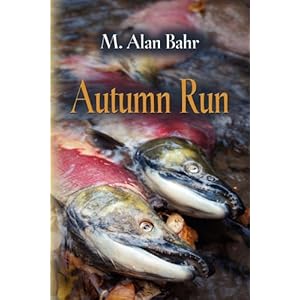
Why I Wrote Autumn Run

product coverThe compelling question that was on my mind when I wrote Autumn Run was this: What do we do when something we value stands in jeopardy's way and there is nothing we can do to prevent its ultimate loss?  This was especially important for me to investigate, because for most of my life I'd believed there was only one excuse in life: I didn't want it badly enough.  That was part and parcel of my faith.  If I wanted something badly enough--whether it was to earn a billion dollars or become president of the United States--I could accomplish it.  Then gradually I realized what people learn when they're diagnosed as terminally ill, or are subject to natural disasters, or work all their lives to see their retirement savings lost in a market crash.  I wield very little control over my life. 

Do we ever get comfortable with the uncertainty that accompanies our lack of control?  In a way, this question helped usher in my search for a new Christian ethic.

Here is the novel's prologue that establishes the premise. 
__________________________________________

Patch ignored the squawk of his plane’s stall alarm and bucked a shifting crosswind.  The Cessna heaved and fishtailed as though fitted to a warped track across the sky.  Two dozen feet over an alpine lake and angled all but crabwise by the gale, he brought the nose up and felt the floats reach forward.  Seconds later he eased back on the throttle and the plane caught choppy water that left the windshield awash with spray.
He turned on the wipers and headed for a rocky beach at the foot of slate-colored mountains.  Near the base of a haulout his client was packing gear and taking down an orange tent.  Patch coasted to shore where ice shattered in his path and the floats scraped coarse gravel.  He opened the door and leaned outside, his body all gaunt lines and restless angles.  His long graying hair tossed about in the cold wind.
“Let’s be quick,” he hollered.  “Bad weather’s on its way.” 
What he didn’t say was the notion most on his mind—that he should have put his foot down and stuck with their original takeout plan.  They were pushing their luck to be in the air with a storm brewing.  The client stumbled over loose shale to the water’s edge.  His jeans and fleece jacket were grimy with campfire ash and dried blood.  He carried a full pack that he hoisted up to Patch. 
“Thanks for the extra dayshike,” he said.  “I got a nice bull—three brow tines, big rack.”
Patch nodded congratulations, but thought: A moose that size won’t be an easy haul.  He looked at the hunter’s sweat-stained face, his tired eyes and greasy hair, and guessed the man had missed more than his morning coffee.  “You don’t seem too excited,” he said.  “In fact, you look like hell.”
“Nothing that a hot shower and a meal won’t fix.”
Patch set the pack down and folded his arms.  “Even so, we’ll be traveling through rough weather.  Find a bag or a piece of tarp, anything, and stick close to it.  Okay?”
The man nodded.
They stowed the quartered moose and the remaining gear and Patch shoved the plane off.  He guessed at the distance to the opposite shore and considered the altitude needed to ferry into the pass.  He fed the engine and heard the moose rack and meat shift in the pod below.  With the float rudders down to hold direction, Patch squared off into the squall.  The wind moaned and tossed rivulets of water over the plane’s cowling and windshield.  He powered through the chop, breaking the water’s suction by raising first one float, then the other.  The shore loomed menacingly close, but he eked enough lift to rise and take to the sky.
“Damn,” he said, “we’re packing a load.”
They circled out of the narrow neck of the draw and into clouds that gathered between the mountains.  Wet snow fell at times, as did rain.  Patch took his bearings from the brief moments when the sky opened and he could see terrain.  He settled into a rhythm marked by the pitch and keel of flight and bad weather.
Halfway through the pass, the fog thinned and a river appeared flowing through a pastel carpet of tundra.  Patch saw a speck of color that he puzzled over until it disappeared behind a hummock of ground.  He tilted the yoke and the plane lurched and came about.  The stall warning droned briefly.
“What are you doing?” the client asked.
“I might have seen a tent down there.”
The plane held its circle, at various times propelled crosswise, abreast, and headfirst into the storm.  Each moment exposed them to a separate and distinct battering.  The client covered his face with wind-chapped hands and groaned.
“Got a bag?” Patch asked.
“I forgot.”
Patch scanned the cockpit and snatched a map from above his visor.  He snapped the paper open.  “Here,” he said before handing it over.
The man retched and coughed, then he retched some more.  Patch cracked open his window and searched the tundra again, his face as impassive as the boulders that littered each mountainside.  Suddenly he straightened in his seat.
“Oh, hell.  Somebody’s down there.”
The passenger strained to look out the pilot-side window.  “You’re not going to land, are you?  You said we were overweight.”
“Sure, but we can lose what’s in the cargo pod.  A man’s life takes precedence over a game carcass.”  Patch ignored the man’s look of concern and searched for water big enough to support a landing.  “The river looks shallow,” he whispered.
The plane reeled as if it had struck and broke through a wall.  Once again the client bent over the paper in his lap.  The stench of vomit filled the plane.  “What should I do with this?” he asked, holding out the sagging paper.
“Hang on.  I’m taking a closer look.”
The plane dipped again, this time without holding a circle.  The stall light and buzzer came on and didn’t shut off.  They plunged and bobbed and fell again.  The client dropped the soaked map at his feet and looked forward with wide, startled eyes. 
“Please, can’t you just call somebody?”
Patch pulled the plane out of its sharp descent and felt his stomach fall through the seat.  They were over the river now, tracking it.  “I’m not within radio distance,” he said.
“Maybe you can wait until we get home?”
“We’re in Alaska, Mister.  No one’s walking out of this storm.”  The clouds had darkened and snow swirled with dizzying effect.  Despite his earlier claim, Patch grasped the radio transmitter and spoke into it.  Only white noise came in reply.
“Maybe he plans to float out,” the client said.
Patch shook his head.  “Did you see a canoe or a raft?  And for your information Kaknu is nearly two-hundred miles away—one hell of a walk in muskeg and bad weather.  I doubt you’d want to hike it.” 
The river drew closer, until its rocky bottom came into view and the curved bank ahead surprised Patch with its proximity and steep rise.  Inches from touching down he knew the effort would ground them—maybe even do worse.  He pulled the throttle back, risking a stall.  The client gritted his teeth and closed his eyes just as the plane grazed the spruce tops along the far ridge. 
“You’re going to kill us,” he said.
No, Patch thought, but we might be leaving a man to die.  As he maneuvered the plane up and away, he stole anxious glances into the river valley from where they’d come.  He pleaded silently, don’t let this happen—please, not again—but it was too late.  At a height above the mountains Patch turned for a final look and saw an opaque wall of haze that reached from ground to sky.  Where the clouds passed, he knew, winter was claiming its territory and leaving the land desolate.

April 21, 2011

The Greatest Reward

The most unique of Mormon beliefs is probably the notion that God is an exalted man.  This was the gist of a eulogy Joseph Smith gave at the funeral of a friend, which was subsequently recorded and is now referred to as the King Follett Discourse.  While many people outside the LDS church take a dim view of the doctrine, its corollary—that human beings, in turn, are capable of becoming Gods—elicits an even stronger knee-jerk reaction.  Antagonists of the church say the idea of aspiring to be God’s equal is a sacrilege. 

I won’t argue one way or another whether it’s truly within the grasp of humans to evolve into Gods, but I will question why anyone would want to do so.  My astonishment is especially understandable in light of an experiment I’ve been known to conduct with members of the LDS faithful.  Here’s how the experiment goes. 

After sidling up to a church member, I ask: “If given the opportunity, would you want to become the world’s supreme leader?“

After a quizzical look, the respondent typically says, “I don’t think so—no.” 

“Really?  Would you consider serving as president of the United States?”

“Nope, not that either.” 

“How about governor of a large state—California, for example—would you accept that position?” 

“With its budget problems?  No way.”  

“What about CEO of a multinational company—let’s say, Exxon Mobile—would you accept that responsibility?”

Even here the answer is invariably, “No.”

“Then, in that case,” I reply, “why would you ever want to achieve exaltation?” 

Now, Mormons are not without answers.  Typically they say something to the effect that only in the highest degree of glory are people able to live together with God and their families.  The basis for that belief is the LDS doctrine that there are multiple levels of reward in heaven, with exaltation being the highest.  (But in that regard it has always seemed odd to me that God won’t allow family members to see each other when they’re relegated to lower kingdoms).  Yet that’s not the end to the benefits of exaltation.  Mormons believe that as Gods they’ll be capable of eternal increase, which is to say, they’ll be able to create new worlds without end and populate them with their own children.

What I’m about to say may sound crass, but I have to be honest and describe the reaction to this doctrine at play in my head.  I’m not sure if the appeal of exaltation is in the infinite number of children a God can have, or if it’s the conclusion one might reach that only exalted beings can engage in the process—I think you know what I mean—of making children.  Putting that question aside, however, let’s consider the implication of this so-called blessing. 

Let’s say you perform admirably in life and for your reward you’re offered the greatest of all gifts: Exaltation.  Excited, you begin to create worlds and populate them with children whom you love dearly.  Then hoping for the best, you watch your children from afar, unable to direct their affairs except through sacred texts that many will misunderstand and some will misinterpret for gain.  You try to talk to them in prayer, but they find that means of communication difficult.  In ways that horrify you, your children begin to brutalize each other.  Many who are in positions to render assistant, ignore—and even prey upon—their less fortunate siblings.  War and devastation result.  If you accept the precedent of our Old Testament Father as morally correct, you become so upset, you consider eliminating your race of children altogether. 

Even if things do work out in the end, how can you watch for a moment while these acts go on?  As for me, I’d turn down the chance.  Give me instead the opportunity to build a small cabin, grow a garden, make a few good friends and occasionally write a perfect and true sentence.  I’m not sure if there is an afterlife, or if what I’ve just described is possible, but if our souls are eternal, I’d hope to live it simply. 

April 17, 2011

The Myth of Damnation

I have three sons who are kind and intelligent, but one of them gave me fits when he was young.  He got into nearly every kind of trouble you can imagine and even spent three nights behind bars after doing something especially bone-headed.  My wife and I spent a significant portion of our free hours and sleepless nights wondering what to do about him, but never--not once--did we consider giving up on the kid. 

In fact, I was thinking of him when I wrote the following:

When I tell them, “Be careful,”
And my children nod in a way
That suggests more weighty thoughts
Are roaming through their heads,
Like: What’s for dinner?

A feeling emerges—
Spontaneous and irrepressible—
From the same place
Gratitude is born:

I loved them before they could walk,
And also before they could speak,
I can do no less now,
Though they seem deaf
To good advice.

Why do we believe a loving God would feel any differently?  To assume God damns His children is to believe He gives up on them.  I can't imagine what might have happened if we hadn't loved our son unconditionally and did everything in our power to effect a turnaround in his life.  As it now stands, he's working on a PhD in biology, specializing in the mechanisms that cause gene mutation.  He recently earned a National Science Foundation Honorable Mention.  I anticipate great things from him.

If being a father and grandfather has taught me anything, it's that children deserve our uncompromising love and devotion.  I refuse to believe in a God who doesn't feel the same way.  Play the video of my granddaughter below and tell me you disagree.